Rail Corrugation Monitoring on Metro Networks
RECOVIB Tiny S2
Contact us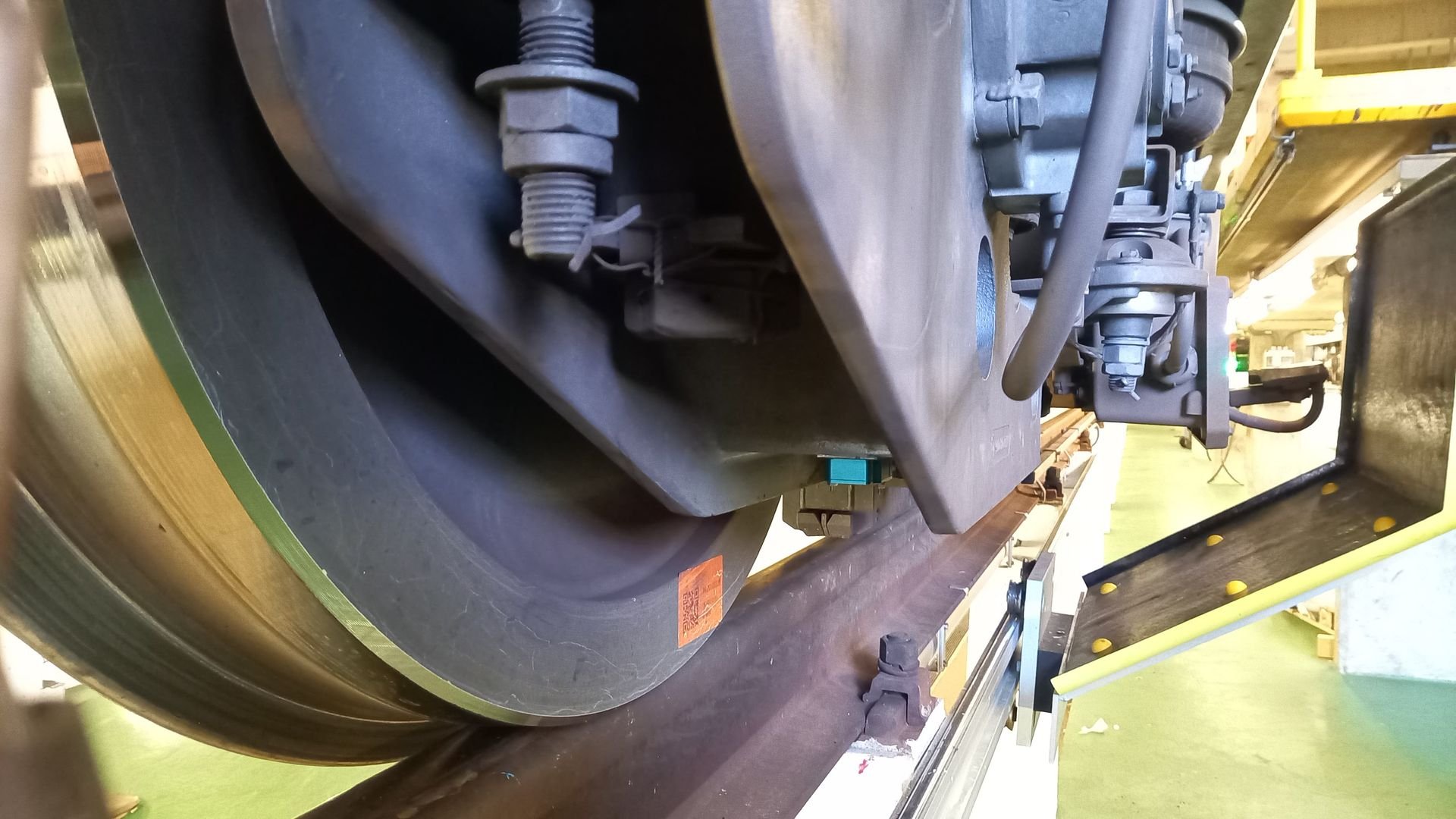
What we do
We provide metro and urban rail operators with a fast way to measure what happens at the wheel and rail interface, without a dedicated measurement vehicle and without taking track out of service. A compact wireless recorder is mounted on a bogie axle box, the vehicle runs its normal service, and the data is retrieved and post-processed at the end of the campaign.
Repeated over time, these campaigns turn rail condition into something an operator can follow rather than estimate.
Advantages
Rail corrugation on the STIB-MIVB network, Brussels
Rail corrugation is a familiar problem on urban and metro networks. Repeated wheel and rail interaction gradually creates a wavy wear pattern on the railhead, most of all in curves. The consequences are well documented: more rolling noise, faster wear of track and rolling stock, reduced passenger comfort, and rising maintenance costs.
Rail grinding is the usual countermeasure, and it is traditionally scheduled at fixed intervals. Corrugation, however, develops at very different rates depending on traffic, vehicle dynamics and track geometry. A fixed calendar therefore grinds some sections before they need it and leaves others too long, without ever telling the operator where the phenomenon is actually concentrated.
STIB-MIVB, the Brussels public transport operator, runs periodic vibration measurement campaigns to answer that question. The RECOVIB Tiny S2 is mounted directly on the bogie axle box of a metro vehicle and records during normal commercial service. No dedicated measurement run, no track possession, no intervention on the vehicle beyond fixing the recorder in place.
Corrugation on metro track typically shows short wavelengths. At commercial speed, the resulting excitation sits high in the frequency range, which is precisely why bandwidth matters here: the Tiny S2 records up to 1 000 Hz in a housing small enough to fit in the limited space available around an axle box.
By comparing vibration signatures from one campaign to the next, maintenance teams can identify the zones where corrugation develops fastest, follow how rail condition evolves, and plan grinding where the track actually needs it. The operator moves from a fixed maintenance interval to an assessment based on measured condition, which removes interventions that were not necessary and concentrates effort where it pays.
Used solution
The RECOVIB Tiny S2 is a wireless miniature three axis vibration recorder. Its size, autonomy and wireless operation are what make recurring on-vehicle campaigns realistic on a network that runs with very little downtime. Measurement data is extracted after each campaign and post-processed in Recovib Suite.
Solutions used: