Monitoring Rock Excavation Next to a Porto Hotel
Recovib Tremor
Contact us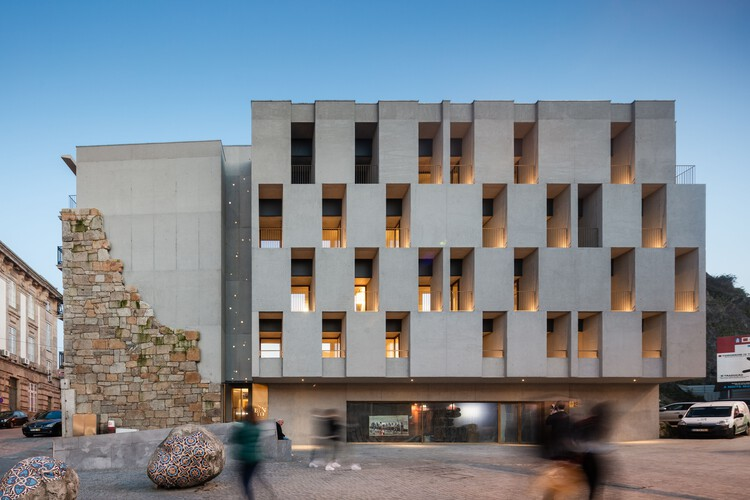
Application
This summer 2026, a redevelopment project started immediately next to a tourist apartment hotel in central Porto. The adjoining buildings were demolished first. The foundations of the new development then had to be cut into the underlying rock, which was done with a large hydraulic breaker working only a few meters away from the hotel's party wall.
Clearly perceptible vibrations were observed throughout the working day. Concerned about this, the hotel owners wondered whether the repeated hammering into rock, day after day, was a risk for the building itself.
To address this, they called upon NCREP company which contacted Micromega Dynamics for the measurement side of the assignment. Two RECOVIB Tremor monitoring stations were rented for a one-month campaign and installed on the ground floor, as close as possible to the foundations. The building has no basement level.
Monitoring & Norms
Both stations recorded continuously and streamed their measurements over 4G to the Recovib.IO cloud platform, where the data was formatted according to two structural damage standards:
Breaking rock produces exactly the type of repeated impulsive events these standards are written for. Recovib.IO processes measurements natively against both frameworks, so the same events were reported in a locally compliant format and against a second widely accepted benchmark, with no manual post processing.
Micromega Dynamics provided the hardware, the data collection and this formatting work. The interpretation of the records and the engineering conclusions drawn from them were carried out by NCREP.
Client profile
NCREP is a structural engineering consultancy based in Porto, founded in 2011 as a spin-off of the University of Porto. It specializes in the inspection, diagnosis, structural and seismic assessment, strengthening and monitoring of existing buildings, with recognized expertise in masonry, timber, concrete and steel structures. Its references include some of Portugal's most significant heritage buildings.
Used Material
Two RECOVIB Tremor all-in-one vibration monitoring stations were rented for one month. Each unit integrates a high resolution 3-axis accelerometer, a multi purpose acquisition system, a 4G router and its power supply in a single IP65 enclosure. In an occupied hotel this mattered, because the installation had to be quick, discreet and required no IT work on site.
Renting rather than buying suited the assignment: the monitoring need was limited to the duration of the excavation work, and the devices were returned once the campaign ended.
Solutions used: