
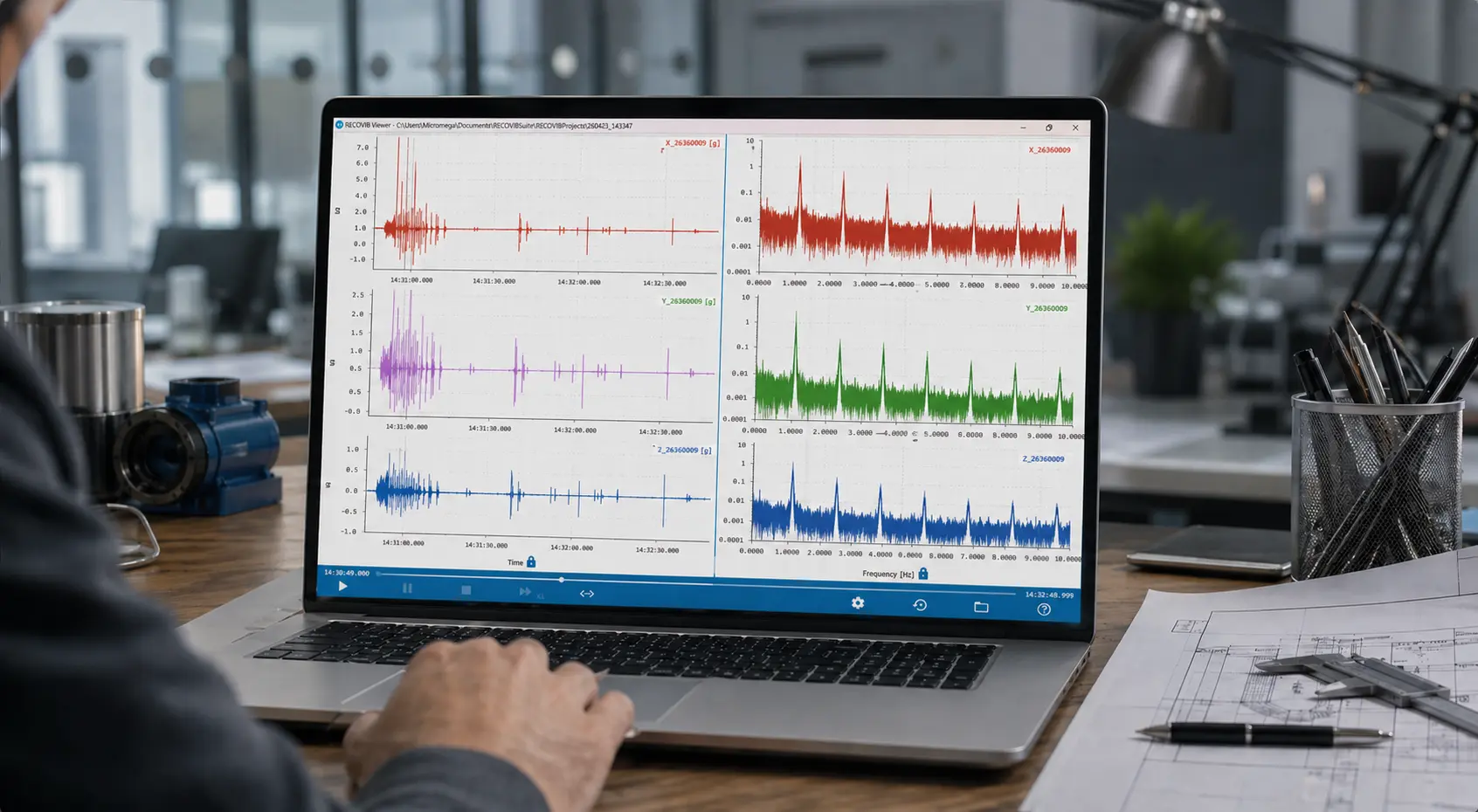
Reliable vibration monitoring has become fundamental across engineering disciplines—from structural diagnostics to rotating machinery health and high-precision industrial processes. A modern vibration monitoring system integrates sensors, data acquisition, analytics, and remote connectivity to deliver accurate and actionable insights, whether for short investigations or long-term surveillance.
This article provides a technical, engineer-focused overview of vibration monitoring principles, the role of high-resolution accelerometers, and how advanced systems support continuous monitoring, trend analysis, waveform diagnostics, and predictive maintenance.
1. What Defines a Modern Vibration Monitoring System?
A vibration monitoring system is an integrated measurement solution designed to capture, transmit, and interpret vibration signals in real time or over extended periods. It typically consists of:
- Sensing — high-resolution, often triaxial accelerometers
- Acquisition — robust data loggers with appropriate sampling rates
- Connectivity — remote transmission (e.g., 2G/4G routers)
- Analytics — local or cloud-based processing, dashboards, reports, alerts
For engineers, the system’s value lies in its ability to deliver repeatable, noise-stable, and high-integrity data, even in harsh environments. Rugged, waterproof enclosures (IP67) and autonomous cellular communication, typical of Micromega’s field devices, are now essential for reliable deployment.
2. Accelerometers for Vibration Measurement
High-quality accelerometers for vibration measurement determine the sensitivity, bandwidth, and overall diagnostic capability of the system.
Technical factors engineers typically evaluate:
- Noise floor and resolution for detecting low-amplitude signals
- Frequency range appropriate for structural, mechanical, or high-frequency monitoring
- Axis count (triaxial sensors capture full spatial motion)
- Environmental robustness (temperature stability, shock resistance, IP rating)
- Ease of field installation (mounting, alignment, power supply)
Recent advances in MEMS accelerometers make them particularly attractive: compact, low-power, mechanically robust, and stable over long-term deployments.
Micromega’s triaxial MEMS accelerometers combine high or ultra-high resolution with rugged IP67 housings, allowing measurement campaigns to be launched quickly and reliably.
3. Continuous Vibration Monitoring
While event-based measurements capture discrete vibration incidents, continuous vibration monitoring provides a full understanding of system behavior over time.
Benefits include:
- real-time detection of deviations,
- improved signal interpretation through uninterrupted datasets,
- better correlation between operational states and vibration response,
- early identification of structural or mechanical anomalies.
Continuous monitoring is essential in environments where vibration levels change dynamically—manufacturing processes, rotating equipment, precision operations, and long-term structural assessments.
Micromega’s connected instruments with embedded cellular routers enable autonomous continuous monitoring without requiring on-site infrastructure.
4. Machinery Condition Monitoring
In industrial applications, machinery condition monitoring relies heavily on vibration analysis to detect early-stage faults in rotating equipment.
Common vibration indicators include:
- Bearing degradation → increased high-frequency content
- Imbalance → dominant amplitude at rotational speed
- Misalignment → harmonic signatures and phase changes
- Looseness → broadband increases and irregular impacts
A vibration monitoring system enables:
- early fault detection,
- improved maintenance planning,
- lower operational risk,
- data-driven asset management.
Portable and autonomous sensing units allow engineers to deploy monitoring campaigns without requiring specialist intervention—an advantage especially important for small teams or remote sites.
5. Vibration Trend Analysis
Vibration trend analysis evaluates how vibration indicators evolve over time, making it a fundamental tool for predictive engineering.
Trend analysis allows engineers to:
- identify progressive degradation,
- detect resonance or modal shifts,
- differentiate operational variability from structural changes,
- anticipate maintenance requirements.
Cloud platforms, such as Micromega’s Recovib Cloud, streamline the visualization of long-term trends, alerting thresholds, and automated reporting.
6. Vibration Waveform Analysis
Where trend indicators provide a macroscopic view, vibration waveform analysis delivers high-resolution diagnostic insight.
Waveform analysis helps engineers understand:
- transient events, shocks, and impacts,
- time–frequency interactions through FFT or advanced transforms,
- harmonic and subharmonic patterns,
- differences between structural and mechanical sources.
Waveform-based alerts and automated data capture—triggered when thresholds are exceeded—give engineers a precise, time-synchronized window into abnormal behavior.
Conclusion: Toward Smart, Connected Vibration Monitoring
Across industries, engineers increasingly rely on robust, connected, high-resolution vibration monitoring systems to support decision-making, reduce uncertainty, and improve operational resilience.
The combination of:
- rugged triaxial MEMS accelerometers,
- continuous and autonomous monitoring capability,
- high-integrity waveform and trend analytics,
- remote connectivity through integrated 2G/4G routers,
- cloud-based visualization and reporting
is transforming how vibration data is collected and interpreted.
Micromega Dynamics contributes to this evolution with field-ready monitoring solutions that deliver reliable, high-quality data while remaining simple to deploy—meeting the expectations of engineers who need performance, robustness, and efficiency in real-world environments.
FAQ – Vibration Monitoring Systems
1. What is a vibration monitoring system?
A vibration monitoring system is an integrated setup that uses accelerometers, data acquisition hardware, and analytical software to measure and interpret vibration levels in real time or over long-term monitoring periods. Engineers use it for diagnostics, predictive maintenance, and structural or machinery health assessment.
2. What type of accelerometers are used for vibration measurement?
Engineers typically use triaxial MEMS or piezoelectric accelerometers for vibration measurement. MEMS accelerometers offer high resolution, low noise, and mechanical robustness, making them ideal for long-term monitoring in harsh environments.
3. What are the benefits of continuous vibration monitoring?
Continuous vibration monitoring provides uninterrupted data, enabling early detection of anomalies, improved signal interpretation, and better correlation between operational states and vibration behavior. It is essential for applications where vibration levels vary dynamically.
4. How does machinery condition monitoring use vibration data?
Vibration data reveals early indicators of mechanical faults such as bearing wear, imbalance, misalignment, and looseness. Condition monitoring systems transform vibration signals into diagnostic insights that support predictive maintenance and reduce unplanned downtime.
5. What is vibration trend analysis?
Vibration trend analysis evaluates long-term changes in vibration indicators. Engineers use it to detect gradual deterioration, resonance patterns, operational shifts, or structural changes. Trend metrics are essential for predictive maintenance strategies.
6. What is vibration waveform analysis?
Waveform analysis examines the raw time-domain vibration signal to identify transient events, impacts, harmonics, and spectral characteristics through FFT or time–frequency transforms. It provides high-resolution diagnostic insight beyond basic peak or RMS values.
7. Can vibration monitoring systems operate autonomously in the field?
Yes. Modern systems equipped with rugged enclosures, integrated cellular communication, and cloud connectivity can run autonomously for long periods. Devices such as triaxial MEMS-based units support remote access, automated alerts, and continuous data uploads.
8. How do engineers choose the right vibration monitoring system?
Selection depends on measurement bandwidth, noise floor, deployment environment, installation constraints, power autonomy, and required analytic capabilities (trend, spectrum, waveform). Applications may require portable units, long-term systems, or cloud-integrated platforms.
9. Are vibration monitoring systems suitable for both structural and mechanical applications?
Yes. High-quality accelerometers and flexible data acquisition make these systems suitable for buildings, bridges, industrial machinery, rotating equipment, and vibration-sensitive processes. The same core technologies apply across sectors with different analysis methods.
10. What industries benefit most from vibration monitoring?
Industries such as civil engineering, manufacturing, energy, precision industry, transportation, and research facilities rely heavily on vibration monitoring for safety, process stability, and equipment reliability.