Understanding the DIN 4150 Standard: Vibration and Construction Monitoring
When construction begins, whether it’s deep piling, renovation in an urban area, or installing heavy machinery, vibrations quickly become a concern. They can affect both the comfort of nearby occupants and the structural integrity of buildings.
The DIN 4150 standard provides a clear reference framework to evaluate these effects. It is divided into two essential parts: Part 2, which addresses human comfort inside buildings, and Part 3, which deals with the impact of vibration on structures.
Human comfort: DIN 4150-2
Imagine an apartment next to a demolition site. The goal is not to eliminate all vibration, that would be impossible, but to ensure that vibration levels remain below the threshold of annoyance or disturbance.
DIN 4150-2 defines those thresholds. It focuses on vibration velocity within the 1 to 80 Hz range and specifies how to measure and evaluate comfort depending on building use (residential, offices, hospitals, etc.).
For vibration engineers, this means using the right sensors, covering low frequencies accurately, and placing sensors where people actually feel the vibration.
Structural integrity: DIN 4150-3
The DIN 4150-3 standard focuses on the building itself. It assesses whether vibration could lead to cracks, deformation, or a loss of serviceability.
Measurements are based on Peak Particle Velocity (PPV), typically expressed in mm/s, and on the dominant frequency of the vibration.
The standard provides limit values depending on the type of structure, from standard masonry to sensitive or historical buildings. Staying below these values means that no structural damage is expected.
Accurate evaluation requires careful sensor placement (on foundations or load-bearing elements) and a comparison of the measured PPV with the reference curves defined by the standard.
How Micromega Dynamics supports vibration monitoring
At Micromega Dynamics, we know that reliable measurements are the foundation of every decision on a site.
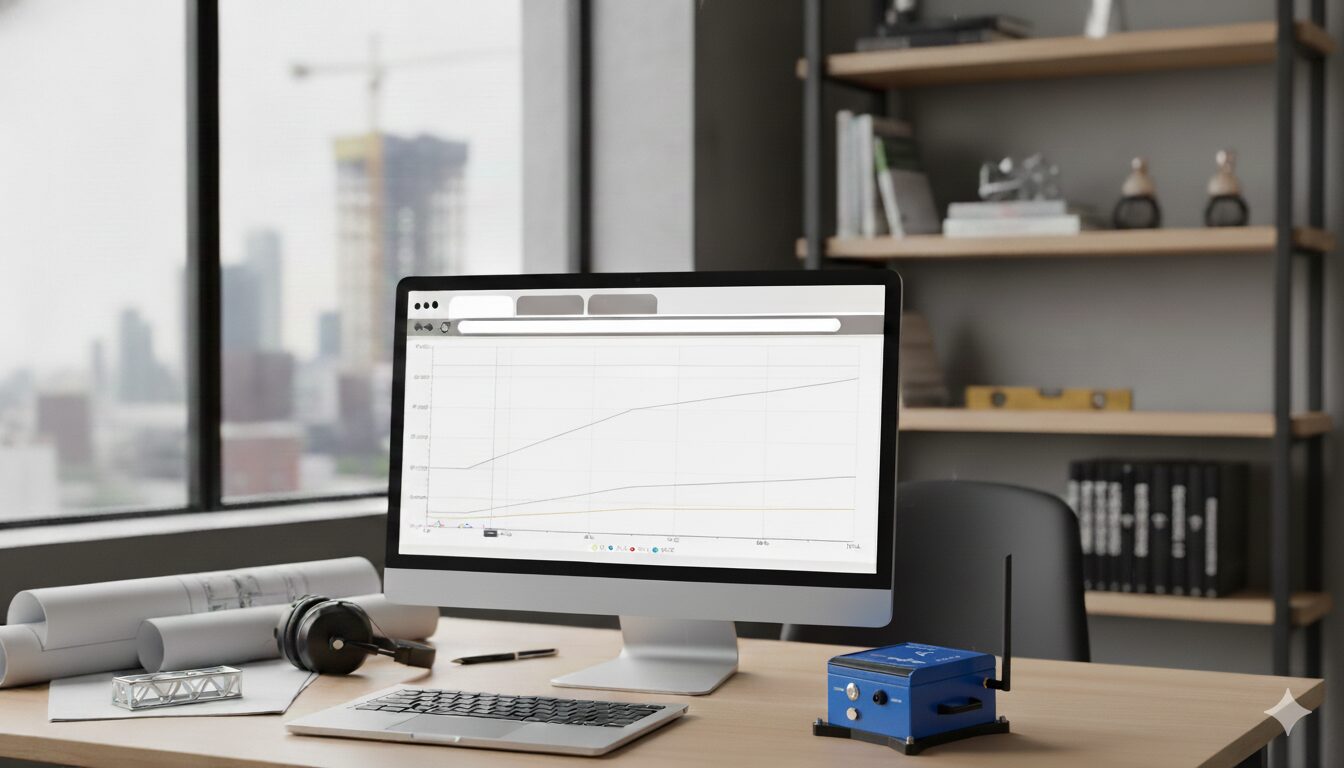
Our Recovib Tremor is specifically designed for low-frequency vibration monitoring, covering signals down to DC, with a flat noise spectrum and industrial robustness (IP67).
In combination with our Recovib Cloud platform, this all in one montoring unit enable fully autonomous DIN 4150-compliant vibration monitoring with visualization, alerts, and automated reporting.
Applying the standard in practice
Theory is one thing; practical implementation is another.
It starts by identifying the goal, comfort or structural protection, then choosing representative measurement points.
Use sensors with appropriate bandwidth and noise performance, ensure solid mounting, and verify calibration. During critical construction phases, record continuously, extract PPV and dominant frequency, and compare to DIN 4150 reference curves.
Well-documented data doesn’t just protect your project from complaints, it strengthens your credibility as an engineering professional.
Why it matters today
Urban construction, deep foundations, or industrial equipment installations often take place near sensitive buildings. Applying DIN 4150 helps you:
-
anticipate vibration-related risks,
-
provide traceable, objective documentation,
-
and optimize mitigation measures without unnecessary cost.
With the right measurement chain, from sensor to cloud platform, your monitoring becomes both reliable and defensible.
Get expert guidance from Micromega Dynamics
Whether you need to set up a vibration monitoring plan, interpret results under DIN 4150, or equip your site with the Recovib Tremor, our engineers can help.
Micromega Dynamics combines hardware expertise and field experience to help you design the right monitoring strategy, from data acquisition to automated reporting.
Contact a Micromega expert to discuss your vibration monitoring project or request a personalized demonstration of the Recovib® system.
Learn more on how to Avoid Complaints from Residents About Vibrations During Demolition