
Vibration Sensors: Technologies, Differences, and Selection Criteria
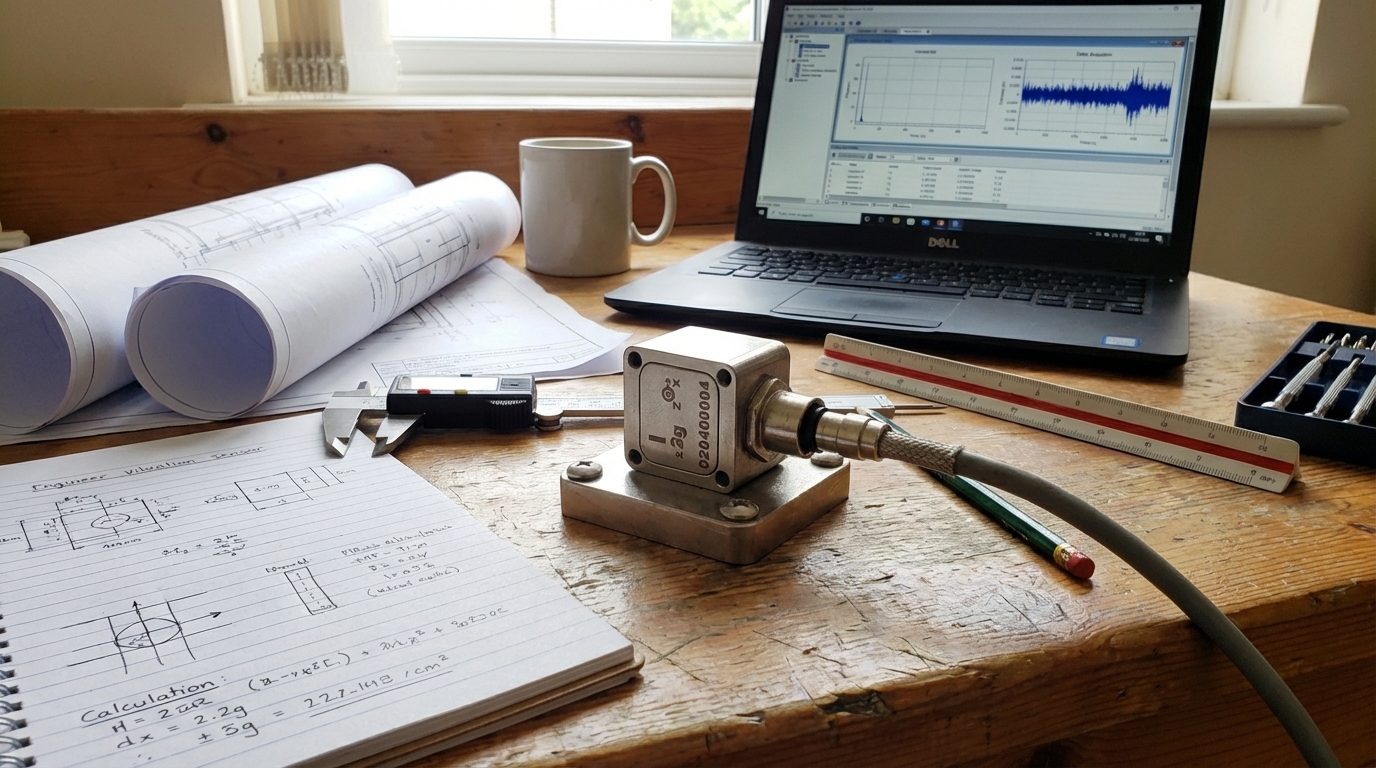
Vibration sensors are at the core of any vibration measurement or monitoring system. They convert mechanical vibrations into measurable signals that can be analysed to assess structural integrity, machine condition, or environmental impact. In Europe, the correct choice and use of vibration sensors is essential to ensure reliable measurements, credible interpretation, and compliance with recognised standards.
This page provides a structured and technology-agnostic overview of vibration sensor types, their differences, and the key criteria for selecting the appropriate sensor for construction and industrial applications.
What Is a Vibration Sensor?
A vibration sensor is a device designed to detect and measure mechanical oscillations of a structure, a machine, or the ground. These oscillations are converted into electrical signals that represent vibration amplitude, frequency, or acceleration.
Vibration sensors are used to:
- quantify vibration levels,
- monitor changes over time,
- detect abnormal or potentially harmful vibration behaviour.
The sensor is the first link in the measurement chain, and its characteristics directly affect data quality and reliability.
Why Sensor Selection Matters
Choosing an inappropriate vibration sensor can lead to:
- inaccurate or incomplete measurements,
- misinterpretation of vibration severity,
- non-compliance with applicable standards,
- missed early warning signs.
In the European context, where vibration assessments are often used for regulatory compliance, contractual validation, or dispute resolution, sensor selection is a critical technical decision rather than a purely practical one.
Main Types of Vibration Sensors
Several sensor technologies are commonly used in vibration measurement and monitoring.
Accelerometers
Accelerometers measure vibration by detecting changes in acceleration.
They are characterised by:
- measurement of acceleration (m/s² or g),
- wide frequency range,
- high sensitivity to impacts and shocks.
Accelerometers are widely used in industrial applications and for detecting high-frequency vibration phenomena.
Geophones
Geophones measure vibration velocity and are extensively used in civil engineering and construction.
They are characterised by:
- direct measurement of vibration velocity (mm/s),
- optimisation for low to mid frequencies,
- strong alignment with building vibration standards.
Geophones are commonly used for ground and building vibration assessment on construction sites.
MEMS Vibration Sensors
MEMS (Micro-Electro-Mechanical Systems) sensors integrate vibration sensing into compact electronic components.
They are characterised by:
- small size and low power consumption,
- multi-axis measurement capabilities,
- suitability for long-term or autonomous monitoring.
MEMS sensors are increasingly used in continuous monitoring systems deployed in harsh or remote environments.
Piezoelectric vs MEMS Sensors
Different technologies offer different advantages depending on the application.
| Criterion | Piezoelectric Sensors | MEMS Sensors |
| Frequency range | Very wide | Wide / Very good in low frequency |
| Sensitivity | Very high | High |
| Power consumption | External power | Low power |
| Typical use | Precision diagnostics | Long-term monitoring |
| Size | compact | very compact |
| Field robustness | Good | Very good |
No technology is universally superior. Suitability depends on measurement objectives and constraints.
Which Vibration Quantities Can Sensors Measure?
Depending on sensor type and configuration, vibration sensors may measure:
- acceleration, useful for high-frequency and impact analysis,
- velocity, commonly used for building protection criteria,
- displacement, relevant for low-frequency structural movements.
In many systems, velocity or displacement values are derived mathematically from acceleration signals.
Frequency Range and Bandwidth
The frequency range of a sensor defines which vibration phenomena can be detected.
Low frequencies are associated with:
- ground motion,
- large structural responses.
High frequencies are associated with:
- mechanical faults,
- impacts,
- localised dynamic effects.
Selecting a sensor with an inappropriate frequency range may result in incomplete or misleading measurements.
Sensitivity, Residual noise density, and Dynamic Range
Three performance parameters must be considered together:
- Sensitivity, indicating how strongly the sensor responds to vibration,
- Residual noise density describes the sensor’s intrinsic noise level, independent of the measured signal.
It indicates how small a vibration must be before it can be distinguished from the noise. - Dynamic range, representing the span between minimum and maximum measurable values.
High sensitivity is not always desirable if very high vibration levels are expected.
Single-Axis vs Triaxial Sensors
Sensors may measure vibration along one or multiple axes.
- Single-axis sensors measure vibration in one direction only.
- Triaxial sensors measure vibration along three perpendicular axes.
Triaxial sensors provide a more complete representation of vibration behaviour, especially when vibration direction is unknown or variable.
Wired vs Autonomous Vibration Sensors
Vibration sensors may be deployed as wired or autonomous devices.
Wired sensors typically offer:
- continuous power supply,
- high data bandwidth,
- stable long-term operation.
Autonomous sensors offer:
- faster installation,
- reduced cabling constraints,
- greater flexibility on construction sites.
The choice depends on installation conditions, monitoring duration, and site accessibility.
Environmental and Installation Constraints
In European construction and industrial environments, sensors must withstand:
- dust and moisture,
- temperature variations,
- mechanical shocks and handling.
Ingress protection, mounting method, and mechanical robustness are therefore essential selection criteria.
How to Choose the Right Vibration Sensor
Selecting a vibration sensor requires answering a set of technical questions:
- which vibration quantity must be measured,
- which frequency range is relevant,
- what accuracy is required,
- whether monitoring is short-term or long-term,
- which environmental constraints apply.
The most appropriate sensor is the one that meets measurement objectives reliably and defensibly.
Typical Applications of Vibration Sensors
Vibration sensors are used in:
- construction site vibration assessment,
- building and structural monitoring,
- industrial machinery diagnostics,
- condition-based maintenance programmes,
- environmental vibration studies.
In each case, sensor selection must be aligned with the specific application context.
From Sensors to Measurement Systems
A vibration sensor is only one component of a broader measurement or monitoring system. Data acquisition, processing, interpretation, and reporting are equally important to ensure that vibration data can support informed decisions.