Why Quarries and Mines Must Rely on DIN 4150-3
 A Context Where Vibrations Quickly Become a Sensitive Issue
In quarries and mines, vibrations are normal, blast shots, crushing operations, heavy machinery… they all generate ground motion. But for nearby residents, these vibrations can become a source of concern, especially when cracks already exist in walls or when a building shows signs of fragility. Even unrelated events may be interpreted as being caused by extractive activity.
That’s when tensions arise: perception becomes accusation, and without data, the operator has no objective evidence to rely on.
DIN 4150-3: A Shared Language to Bring Objectivity
To move away from a “feeling versus feeling” dynamic, the DIN 4150-3 standard provides a clear and structured framework. It defines acceptable vibration levels based on building type and vibration frequency.
It does not assess sensations; it evaluates structural risk.
In other words, it allows operators to determine whether a blast or day-to-day activity truly poses a threat to neighboring structures. This distinction completely changes the nature of the dialogue with residents and authorities.
Why Measuring Vibrations Becomes Essential
In many quarries, teams are skilled and know how to manage their blasts safely. But without measurement, it is impossible to demonstrate this. And when a complaint arises, everything relies on trust, something that cannot always be assumed.
Continuous measurement, on the other hand, documents every event: when a blast occurred, what levels were reached, and whether recommended thresholds were exceeded. There is no longer a need to react “based on feeling”, you present facts.
The Need for a Simple, Robust, and Reliable System
For vibration monitoring to be realistic in daily operations, the equipment must be suited to the field. Quarries do not have the time or resources to deploy complex installations with extensive cabling or unstable power supplies.
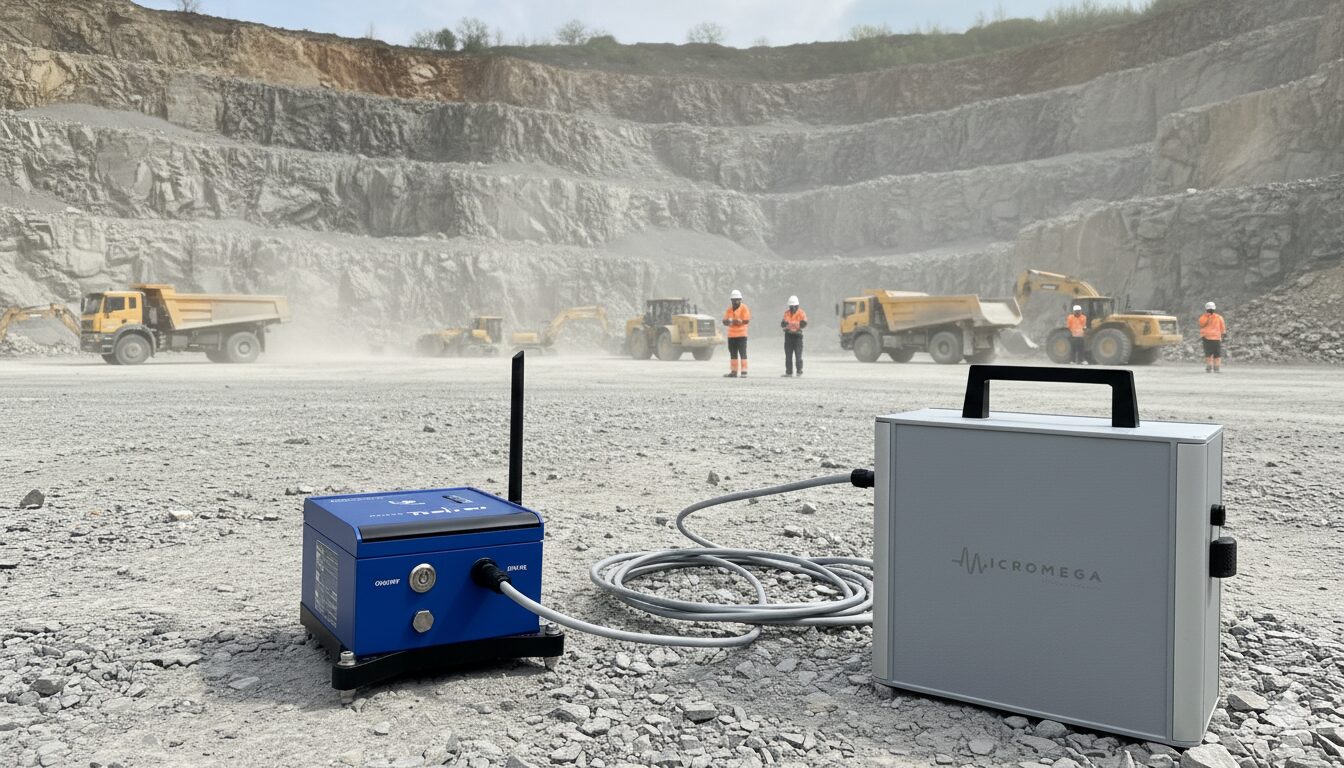
This is why an autonomous device such as the Recovib Tremor is highly relevant: it can be installed in minutes, operates in harsh environments thanks to its IP65-rated housing, performs continuous measurements, and sends data directly over 4G.
The operator can monitor vibration levels, receive alerts in case of exceedance, and access the full event history through the cloud platform.
More Constructive Communication with Residents and Authorities
When concerns arise, discussions change instantly when clear, timestamped data is available. Residents gain clarity on what is actually happening, authorities have reliable historical information, and the operator demonstrates transparency and proactive risk management.
It is no longer a matter of interpretation, it becomes a dialogue grounded in measured values.
Direct Benefits for the Operation Itself
Continuous monitoring also helps teams better understand their own activities.
Some zones produce stronger blasts than expected, certain configurations generate more vibration, and ground response can vary significantly from one area to another.
With data, operators gain better control, and often improve operations as a result.
Measuring to Reassure, Understand, and Improve
Vibrations are part of the job; they won’t disappear. But the way they are managed can evolve. Relying on DIN 4150-3 and on a reliable monitoring system allows operators to work with confidence, reduce tensions, and demonstrate responsible management of their extraction activities.
It is a transparent, responsible, and highly practical approach to maintaining balance between industrial activity and its surrounding environment.