Monitoring vibrations on construction sites and civil engineering projects has become a essential requirement. Urban density, aging infrastructure, strict regulations (DIN 4150-3, BS 7385, etc.), and increasing pressure from residents mean contractors must document and control vibration levels with precision.
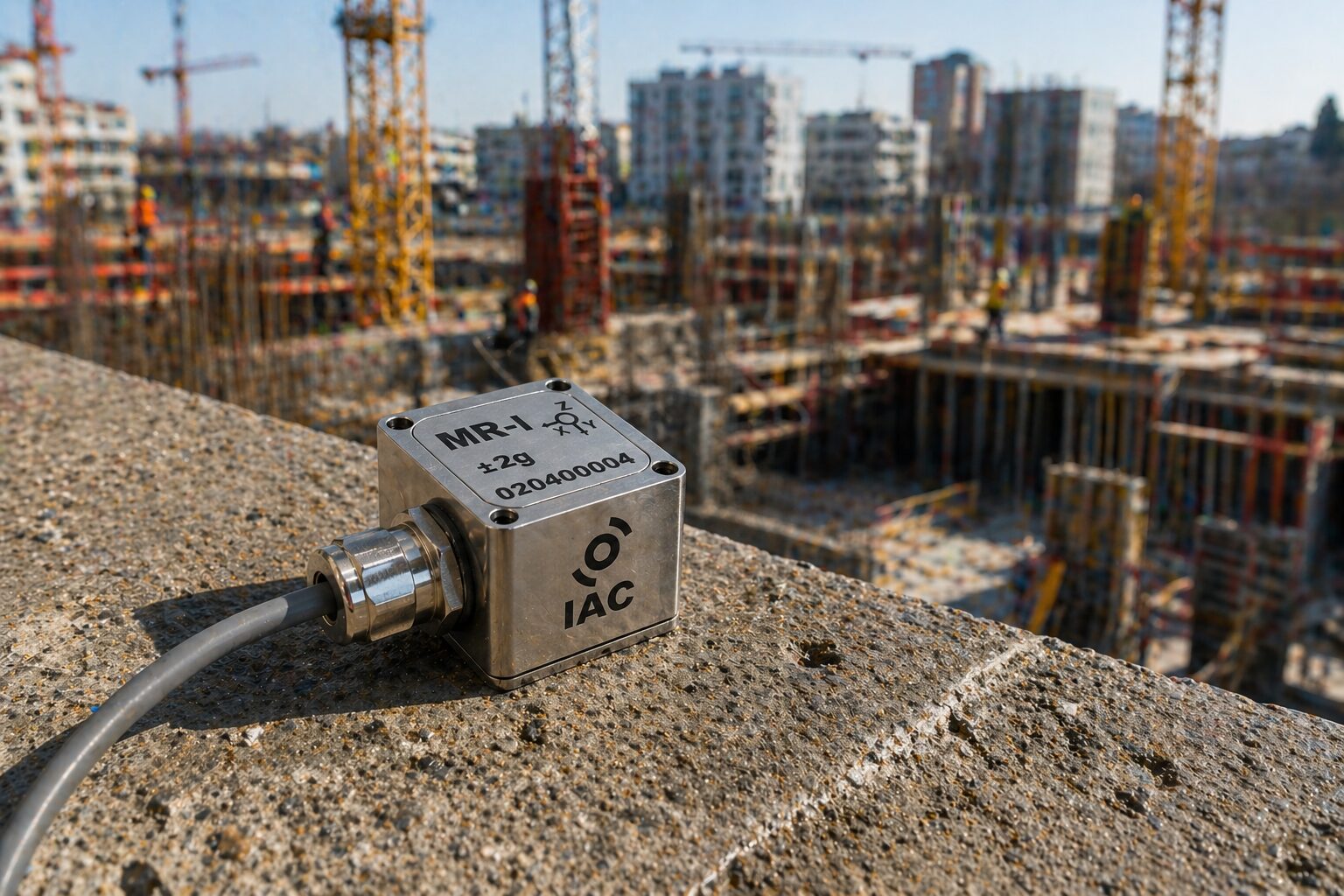
A rugged triaxial MEMS accelerometer specifically designed for harsh environments is now the reference solution — offering accuracy, autonomy, and long-term reliability directly on site.
Why Triaxial MEMS Accelerometers Are the Standard in Modern Construction Monitoring
Civil engineering vibrations propagate unpredictably through soil, foundations, and structures. Measuring only one axis makes data incomplete or misleading.
A triaxial MEMS sensor captures X, Y, Z directions simultaneously, enabling:
- Accurate peak particle velocity (PPV) and displacement calculations.
- Reliable assessment of structural response in real conditions.
- Compliance with geotechnical guidelines.
- Faster interpretation for engineers and project managers.
MEMS technology also ensures excellent thermal stability, low noise density, and reliable performance even during long-term deployments.
Field Conditions Require Rugged, Weatherproof Sensors
Construction sites involve dust, humidity, shocks, vibration, and temperature variations. Instruments must survive all of it without false readings.
A rugged enclosure, IP67 waterproofing, shock-resistant housing, and robust connectors, ensures that measurements remain dependable regardless of conditions.
The TREMOR device from Micromega Dynamics exemplifies this: a fully rugged vibration monitoring unit with embedded triaxial MEMS accelerometer, engineered for demanding field conditions. It is built for construction, demolition, piling, tunneling, blasting, mining, and urban excavation environments.
Remote Vibration Monitoring: A Critical Advantage On-Site
Modern projects require fast decision-making and transparent communication with authorities and residents.
A rugged accelerometer becomes far more valuable when paired with:
- Integrated 2G/4G router for remote access
- Continuous data logging (short or long term)
- Cloud platform for visualization, alerts, and reporting
- Real-time alarms when thresholds exceed regulatory limits
This remote capability drastically reduces site visits, project delays, and unnecessary risk exposure.
Use Cases in Construction & Civil Engineering
1. Urban Construction Near Sensitive Buildings
Triaxial monitoring helps teams ensure that vibration levels remain within acceptable thresholds while excavators, compactors, cranes, and heavy vehicles operate close to inhabited buildings.
2. Demolition & Controlled Blasting
Peak accelerations and PPV values must be measured precisely to avoid structural damage or legal disputes.
3. Tunneling & Underground Works
MEMS sensors maintain reliable data transmission even in rough underground environments.
4. Piling & Deep Foundation Works
Continuous tracking allows engineers to adjust techniques and mitigate complaints.
5. Bridge & Infrastructure Projects
Monitoring dynamic loads supports structural integrity analyses and early detection of anomalies.
Why MEMS Technology Beats Legacy Geophones for Many Applications
- Resistant to shocks and misalignment
- No need for perfect leveling
- More compact and robust
- Lower power consumption
- Ideal for long-term monitoring in harsh conditions
For multi-project contractors, this reduces training, installation errors, and maintenance costs.
Where Rugged Triaxial MEMS Accelerometers Provide the Most Value
These systems are widely deployed across:
- Europe: Belgium, France, Netherlands, Germany, UK
- North America: US and Canada construction and mining sites
- Middle East: major infrastructure and tunneling works
- Asia-Pacific: high-density urban developments
Regions enforcing strict vibration regulations — BENELUX, Germany (DIN 4150-3), and France — particularly benefit from rugged devices that can withstand cold, rain, and heavy site operations.
The TREMOR Advantage (Micromega Dynamics)
Based on the provided information, TREMOR offers:
- Rugged, waterproof IP67 enclosure
- High-resolution triaxial MEMS accelerometer
- Integrated 2G/4G connectivity
- Plug-and-play installation, no technician required
- Cloud platform for visualization, analysis, and alerts
- Suitable for short-term measurements or long-term monitoring
- Flexible rental or purchase options
This makes it especially relevant for site managers, civil engineers, geotechnicians, and independent consultants.
Conclusion
A rugged triaxial MEMS accelerometer is now the backbone of vibration monitoring in construction and civil engineering. It ensures compliance, reduces project risks, avoids complaints, and accelerates decision-making — all while operating reliably in the most demanding environments.
Solutions like TREMOR combine durability, accuracy, and connectivity, offering a complete ecosystem for modern vibration monitoring needs.
FAQ
1. What is a triaxial MEMS accelerometer for vibration monitoring?
It’s a compact sensor that measures vibrations on three axes (X, Y, Z) simultaneously. MEMS technology provides stable, high-resolution data ideal for construction and civil engineering monitoring.
2. Why use a rugged accelerometer on construction sites?
Construction environments expose equipment to shocks, dust, humidity, and temperature variations. A rugged IP67 sensor ensures data reliability and long-term durability even in harsh field conditions.
3. How does triaxial monitoring improve vibration analysis?
By capturing acceleration in all directions, engineers obtain a complete view of ground or structural vibrations. This improves PPV calculation, compliance checks, and structural risk assessments.
4. Is vibration monitoring required for compliance with standards like DIN 4150-3?
Yes. Projects near buildings or sensitive structures often require monitoring to comply with regulations such as DIN 4150-3 or BS 7385. A triaxial MEMS accelerometer helps document and prove compliance.
5. Can vibration data be accessed remotely?
Modern devices with embedded 2G/4G connectivity allow real-time remote monitoring, alerts, and cloud dashboards. This reduces site visits and speeds up decision-making.
6. What construction activities generate the highest vibrations?
Piling, compaction, excavation, blasting, and demolition typically create significant vibrations. Monitoring helps avoid structural damage and resident complaints.
7. How long can a rugged MEMS accelerometer be deployed on site?
High-quality rugged systems can run continuously for months or years with stable accuracy, making them suitable for both short-term measurements and long-term monitoring.
8. What industries use rugged triaxial MEMS accelerometers?
Construction, demolition, tunneling, mining, geotechnical engineering, infrastructure maintenance, and structural health monitoring.
9. Are MEMS accelerometers more reliable than geophones?
For many applications, yes. MEMS sensors are less sensitive to misalignment, more robust, consume less power, and offer excellent repeatability.
10. Can a rugged accelerometer be installed without technical expertise?
Some solutions are plug-and-play and do not require specialist setup. They can be deployed directly on site and configured remotely through a cloud platform.