
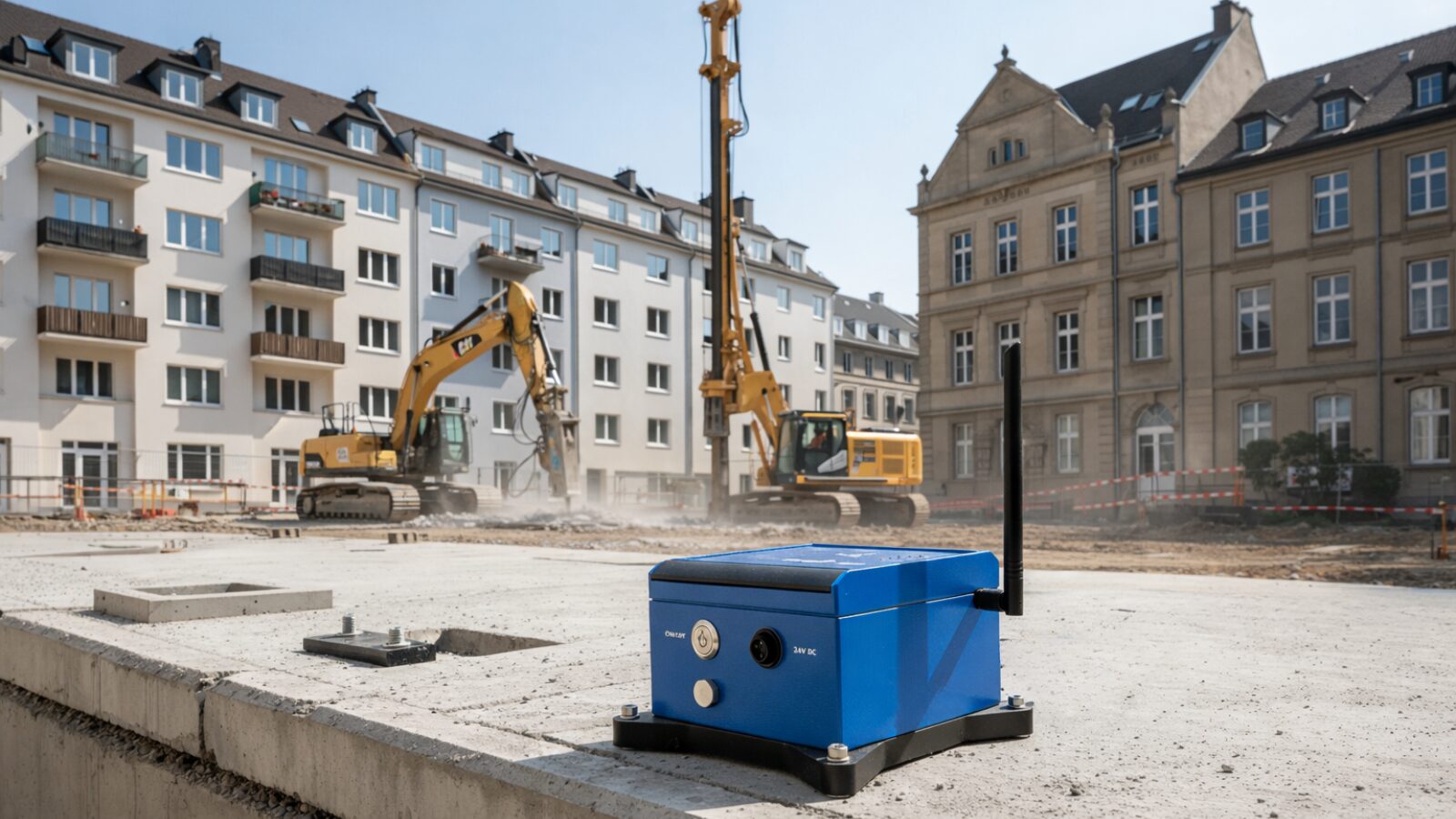
Vibration monitoring on construction sites is increasingly used in Europe to manage risk proactively, protect nearby structures, and demonstrate compliance throughout the duration of a project. Unlike isolated measurements, continuous monitoring provides visibility over time and enables rapid response when vibration levels become critical.
This page explains how vibration monitoring is implemented on construction sites, which risks it addresses, and how it supports operational decision-making.
Why Use Vibration Monitoring on Construction Sites?
Construction activities generate vibrations that vary significantly depending on equipment, soil conditions, and work phases. On European projects, especially in urban or constrained environments, these variations make continuous monitoring a preferred approach.
Vibration monitoring is used to:
- control vibration exposure over time,
- protect neighbouring buildings and infrastructure,
- comply with contractual or regulatory requirements,
- react quickly to excessive vibration events,
- provide objective, traceable documentation.
Monitoring reduces uncertainty by ensuring that vibration behaviour is observed continuously rather than inferred from isolated checks.
Typical Construction Activities Requiring Monitoring
Continuous vibration monitoring is commonly implemented for activities known to generate significant or variable vibration levels, including:
- demolition works,
- pile driving and sheet piling,
- deep drilling and ground improvement,
- operation of heavy construction machinery,
- works near existing buildings or sensitive infrastructure.
In these situations, vibration levels may change rapidly and unpredictably, making spot measurements insufficient.
What Is Monitored During Construction?
A vibration monitoring system typically records multiple indicators to provide a comprehensive view of vibration exposure.
Commonly monitored parameters include:
- vibration velocity (PPV), used as the primary building protection criterion,
- acceleration, useful for identifying impacts and transient events,
- frequency content, helping to identify vibration sources,
- duration and repetition of vibration events.
Monitoring focuses not only on peak values but also on how often and how long vibrations occur.
Continuous Monitoring vs Periodic Checks
Continuous monitoring offers clear advantages over periodic vibration checks:
- all vibration events are captured, including short-duration peaks,
- long-term trends can be analysed,
- thresholds can be applied consistently over time,
- exceedances can trigger immediate alerts.
Periodic checks may still be useful for targeted assessments, but they provide only partial coverage of vibration exposure.
Sensor Placement on Construction Sites
Correct sensor placement is essential to obtain meaningful monitoring results. On construction sites, sensors are typically installed:
- on foundations or load-bearing elements of nearby buildings,
- on the ground between vibration sources and sensitive structures,
- at locations representative of vibration transmission paths.
Placement should reflect the objective of monitoring, whether it is building protection, ground vibration assessment, or source characterisation.
Defining Vibration Thresholds and Alert Levels
Monitoring systems rely on predefined thresholds derived from applicable standards or project specifications.
Thresholds are often defined as:
- warning levels indicating increased vibration risk,
- alarm levels requiring immediate operational response,
- frequency-dependent limits where required by standards.
Careful threshold definition helps avoid both unnecessary alarms and missed critical events.
Real-Time Alerts and Operational Response
Real-time vibration monitoring systems generate alerts when thresholds are exceeded. These alerts enable site teams to:
- temporarily stop or modify activities,
- adjust construction methods or equipment,
- reschedule high-impact operations,
- investigate unexpected vibration sources.
This rapid feedback loop is one of the main benefits of continuous monitoring.
Baseline Monitoring and Reference Conditions
Before construction begins, baseline vibration monitoring is often carried out to document existing vibration conditions. Baseline data provides a reference against which construction-related vibrations can be assessed.
In European urban environments, baseline monitoring is particularly important due to the presence of background vibrations from traffic, railways, or nearby industrial activity.
Data Interpretation and Reporting
Monitoring data must be interpreted in context to be meaningful. This involves:
- comparing results with applicable standards,
- correlating vibration events with construction activities,
- identifying trends rather than isolated exceedances.
Clear and structured reporting is essential to communicate results to stakeholders and authorities.
Managing Complaints and Disputes
One of the key roles of vibration monitoring on construction sites is dispute management. Continuous monitoring provides objective, time-stamped data that can be used to:
- respond to complaints from residents,
- demonstrate compliance or non-compliance,
- support transparent communication with authorities or clients.
This reduces reliance on subjective assessments or anecdotal evidence.
Limitations of Vibration Monitoring
While powerful, vibration monitoring is not a substitute for engineering judgement. Limitations include:
- the need for correct configuration and interpretation,
- potential alert fatigue if thresholds are poorly defined,
- inability to assess structural condition without complementary analysis.
Monitoring should therefore be integrated into a broader risk management framework.
Best Practices for Construction Site Vibration Monitoring
Effective vibration monitoring relies on:
- clearly defined objectives,
- appropriate sensor selection and placement,
- well-defined thresholds and alert logic,
- regular review and interpretation of data,
- clear documentation and reporting.
When implemented correctly, monitoring becomes a proactive risk control tool rather than a passive data collection exercise.
From Monitoring to Proactive Risk Control
Vibration monitoring enables construction teams to move from reactive problem-solving to proactive risk control. By continuously observing vibration behaviour, risks can be identified early, managed transparently, and documented objectively throughout the project lifecycle.