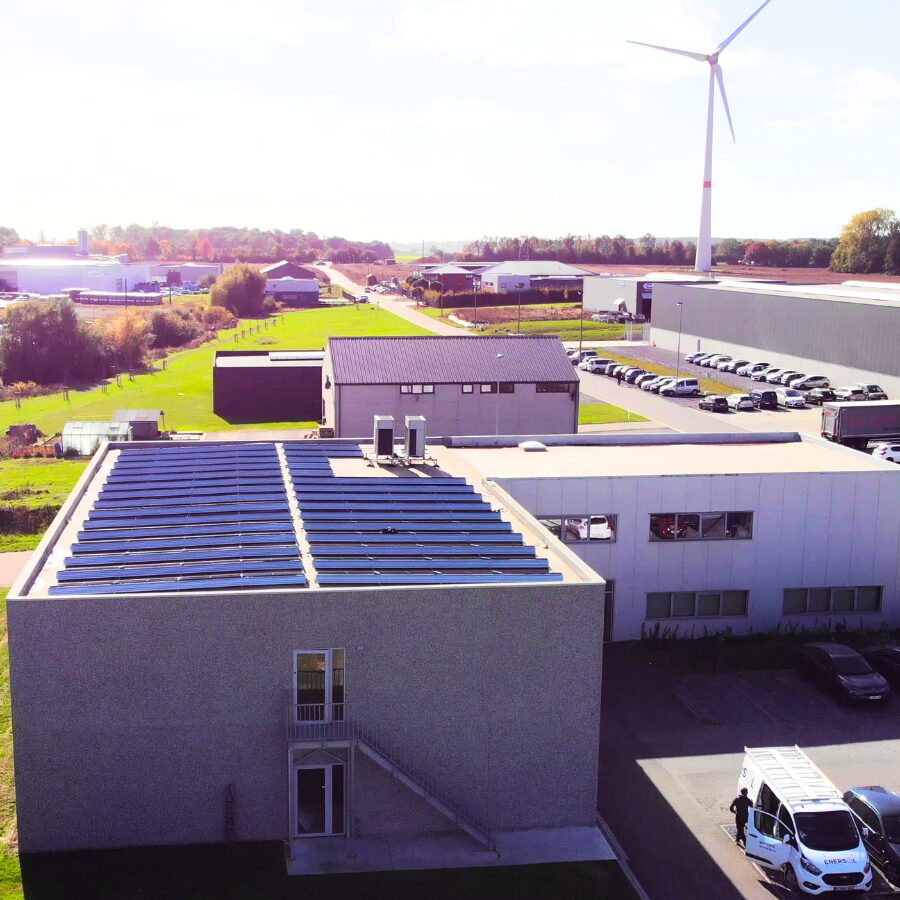

Wind is one of the most complex dynamic actions affecting modern structures. Unlike static loads, wind produces fluctuating forces that vary in intensity, direction, and frequency content. For slender or flexible structures such as high-rise buildings, towers, masts, and long-span bridges, wind-induced vibrations can govern serviceability, durability, and sometimes even structural safety.
Monitoring these vibrations allows engineers to observe how a structure behaves under real atmospheric conditions and to verify whether its dynamic response remains within expected limits over time.
Why Wind-Induced Vibrations Require Monitoring
When wind flows around a structure, it generates pressure variations that can excite the structure dynamically. Depending on geometry and stiffness, this excitation may produce along-wind motion, cross-wind oscillations due to vortex shedding, or torsional effects in asymmetric structures.
In many cases, wind-induced vibrations do not threaten immediate structural integrity. However, they may create excessive motion affecting occupant comfort in tall buildings, contribute to fatigue in structural connections, or reveal unexpected aerodynamic behaviour.
Because wind loading is inherently variable, theoretical design calculations are often complemented by field measurements to confirm actual structural response.
Dynamic Behaviour and Modal Response
Every structure has natural frequencies determined by its mass and stiffness distribution. When wind excitation approaches one of these frequencies, resonance phenomena may amplify vibration amplitudes significantly.
Monitoring wind-induced vibrations therefore typically focuses on identifying modal properties and tracking their evolution over time. Acceleration measurements at selected structural levels allow engineers to evaluate natural frequencies, estimate damping ratios, and quantify response amplitudes under varying wind conditions.
Telecommunication towers are another example of slender structures where modal identification is essential. RECOVIB Feel sensors have been used in this context to support resonance identification and the evaluation of natural frequencies under real operating conditions.
Long-term observation is particularly valuable. If structural stiffness changes due to ageing, connection degradation, or modifications, modal properties may shift. Detecting such changes early supports proactive structural assessment.
Measurement Strategy and Sensor Requirements
Wind-induced vibrations often involve low-frequency and low-amplitude motion. Capturing this behaviour requires sensors with appropriate sensitivity, stability, and long-term reliability.
In structural applications, dedicated monitoring devices such as Recovib Structural Health Sensors are designed to provide consistent dynamic measurements over extended periods. These sensors are typically installed at locations representative of dominant vibration modes, such as upper levels of high-rise buildings or mid-span sections of flexible bridges.
Correct sensor positioning is critical. Monitoring must reflect global structural behaviour rather than localised motion.
Correlating Structural Response with Wind Conditions
Interpreting wind-induced vibration data requires contextual information. Structural response depends strongly on wind speed, direction, and turbulence characteristics.
For this reason, monitoring campaigns often combine vibration measurements with meteorological data. By correlating dynamic response with environmental conditions, engineers can determine critical wind speeds, assess resonance behaviour, and validate aerodynamic models used during the design phase.
Without this contextualisation, vibration amplitudes alone provide limited insight.
Serviceability Considerations in High-Rise Buildings
In tall residential and office buildings, wind-induced vibrations are frequently governed by serviceability criteria rather than ultimate structural strength.
Even when stresses remain well within safe limits, excessive acceleration may lead to occupant discomfort. Monitoring acceleration levels allows asset owners to verify that comfort thresholds are respected and to respond objectively to complaints.
This is particularly important in dense urban environments where perception of motion can quickly become a reputational issue.
Long-Term Structural Implications
Repeated wind loading may contribute to fatigue accumulation in structural elements over decades. Although individual events may not be critical, cumulative dynamic exposure can influence durability.
Long-term monitoring enables engineers to evaluate whether vibration amplitudes remain stable, whether damping behaviour changes, and whether modal properties evolve in a way that suggests structural modification.
When anomalies are detected, further technical assessment may be required. In complex cases, specialised engineering services can analyse structural behaviour in depth, determine the root cause of unexpected response patterns, and recommend mitigation strategies if necessary.
From Observation to Structural Confidence
Monitoring wind-induced vibrations transforms theoretical design assumptions into measurable evidence. By continuously observing how structures respond to real wind conditions, engineers gain confidence in performance, identify emerging risks, and support informed asset management decisions.
When properly implemented, vibration monitoring becomes an integral component of long-term structural reliability rather than a reactive diagnostic tool.